A chatbot works with you. An AI agent works for you.
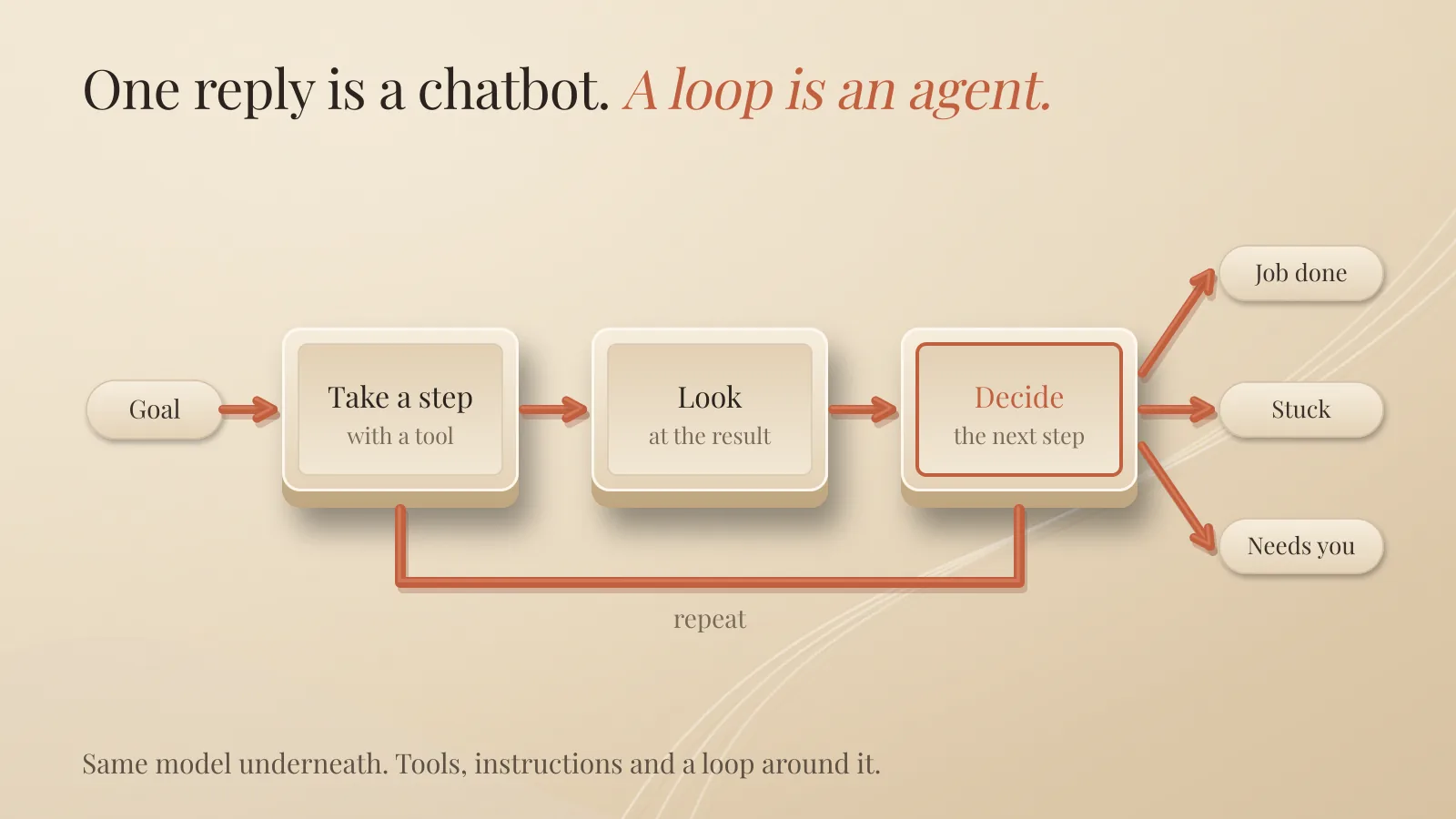
A chatbot answers your message, then waits for the next one. An AI agent gets a goal and keeps going until the job is done, it gets stuck, or it needs you to decide.
That's the whole difference. The rest is detail.
What is the difference between a chatbot and an AI agent, in one example?
A chatbot gives you help. An agent gives you the finished job. One business example makes that clear.
Take a job every business has. Unpaid invoices.
"Check which October invoices are still unpaid, and send each of those clients a friendly reminder."
This is a made-up example, to show the difference. Not a story from my own business.
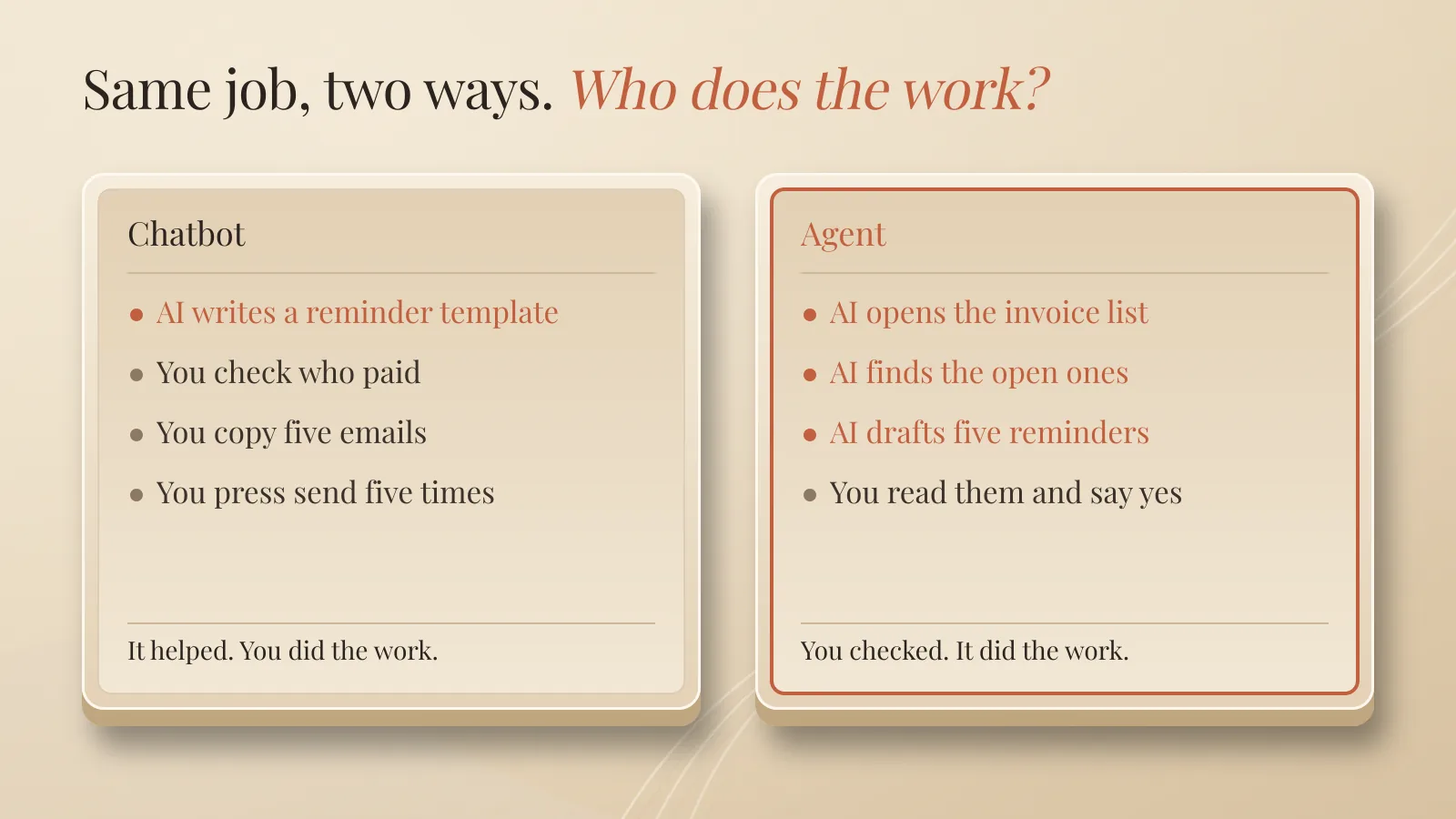
The chatbot can't see your accounting software. It can't see your inbox. So it writes you a nice template and explains how to filter unpaid invoices. Paste the list in, and it writes five emails. Then you check who paid, you copy every email, you press send five times.
The chatbot helped. You did the work.
The agent has access to your accounting tool and your email. It opens the invoice list. It filters on October. It sees which ones are still open. It drafts one reminder per client, with the right name, amount and invoice number. Then it stops and asks: "Five reminders ready. Send them?"
You read them. You say yes. It sends.
You checked the work. It did the work.
What turns a chatbot into an AI agent?
Three things built around the model: tools, instructions and a loop. The model underneath can be exactly the same. The AI didn't get smarter. The setup around it changed.
Tools. The agent can reach your software. The chatbot can only reach your words. Without tools, AI can only talk.
Instructions. The agent knows what it may do alone, and when it has to ask. Drafting is fine. Sending waits for your yes.
The loop. This is the engine. Take a step. Look at the result. Decide the next step based on what actually came back. If the invoice list were empty, the agent would tell you, instead of writing emails to nobody.
One reply is a chatbot. A loop is an agent.
The AI labs say the same in their own guides. OpenAI describes agents as systems that independently get tasks done on your behalf. If the model doesn't control the workflow, it's not an agent, however good the chatbot is. Anthropic describes agents as models using tools in a loop, based on the feedback they get, with clear stopping points and a human checking in.
Is ChatGPT or Claude a chatbot or an agent?
Both. It depends on what you ask and what you give it access to.
My test is simple. Does it only reply? Chatbot. Does it use tools, check the result and choose its next step? Agent.
The app's name doesn't decide that. What it does in that moment decides it.
When is a chatbot enough?
Most of the time. Explaining something. A first draft. Brainstorming. Summarising a document. Translating. None of that needs the AI to touch anything. It needs a good answer.
Anthropic's advice: start with the simplest solution. Add the agent only when it clearly helps.
More parts, more things that break. And agents cost more. Every step is another call to the model. Every call uses tokens. One chat answer can turn into many agent steps.
Simple first. Always.
When should you use an AI agent?
When the job has several steps across several tools. Look it up here, compare it there, fill it in, send it, follow up.
When the chore comes back every week.
When the research needs browsing, opening pages, checking one thing against another.
One more thing. If the steps are the same every single time, you probably don't need an agent. A fixed workflow, written down in advance, is cheaper and more predictable. An agent is for work where the path changes and the AI has to choose its own next step.
What are the risks of AI agents?
A chatbot that's wrong gives you a bad answer. An agent that's wrong does something.
Back to the invoices. A client paid yesterday, but the payment isn't matched yet. The agent sees an open invoice and sends a reminder to someone who already paid. Not a disaster. Not great for the relationship either. Now picture the same mistake with a payment or a deleted file.
Mistakes also stack. An error in step two travels into step three, four and five.
And there's prompt injection: text hidden in an email, a document or a web page, written to trick the agent into doing something you never asked for. An agent that reads your inbox also reads what strangers put in it.
How do you keep an AI agent safe?
Set it up like any system that carries risk.
Money, sending and deleting wait for your approval. The agent only gets the access it needs. It gets a step limit, so it can't run forever. It keeps a log, so you see what it did. And you test it on something harmless before it goes near real clients.
Should you talk or type to an AI agent?
Talk for quick things. Type for anything you want to keep.
You can talk to many of these tools now. Same tools behind it, different channel. "Did the reminders go out?" works fine out loud. Numbers, links and details are better in writing, because writing leaves a trail.
Quick answers
Is an AI agent just a smarter chatbot?
No. Often it's the same model. The difference is the tools, the instructions and the loop around it.
Is an agent always better than a chatbot?
No. For answers and drafts, chat is faster, cheaper and simpler.
Do AI agents cost more than chatbots?
Usually, yes. They take more steps, and every step uses tokens.
Can I try an AI agent without coding?
Some chat apps now have agent features built in. Check your plan. Start small, with something you can easily check.
The takeaway
Start with chat. It covers most of what you do.
When you catch yourself copy-pasting between the chat and three other apps, that's when an agent makes sense.
And in the beginning, keep the send button for yourself.
Further reading: AI Inference Explained and AI Tokens Explained: What You're Actually Paying For
About Me

I’m Laurent Terrijn, an entrepreneur and engineer. I see myself as a systems engineer and business builder: I build the systems businesses run on. I’m also a nerd who somehow ended up speaking ten languages. I love learning, and that curiosity pulled me deep into personal branding and artificial intelligence. On the side, explaining AI has become a passion project. I enjoy taking something that sounds complicated and making it simple enough for busy business people to understand. I do it out of curiosity, and because I like sharing what I find out. Read more on www.laurentterrijn.com
Disclaimer
I used AI to help with drafting, proofreading and checking this article.