Better wording rarely fixes a bad AI answer. Better information does.
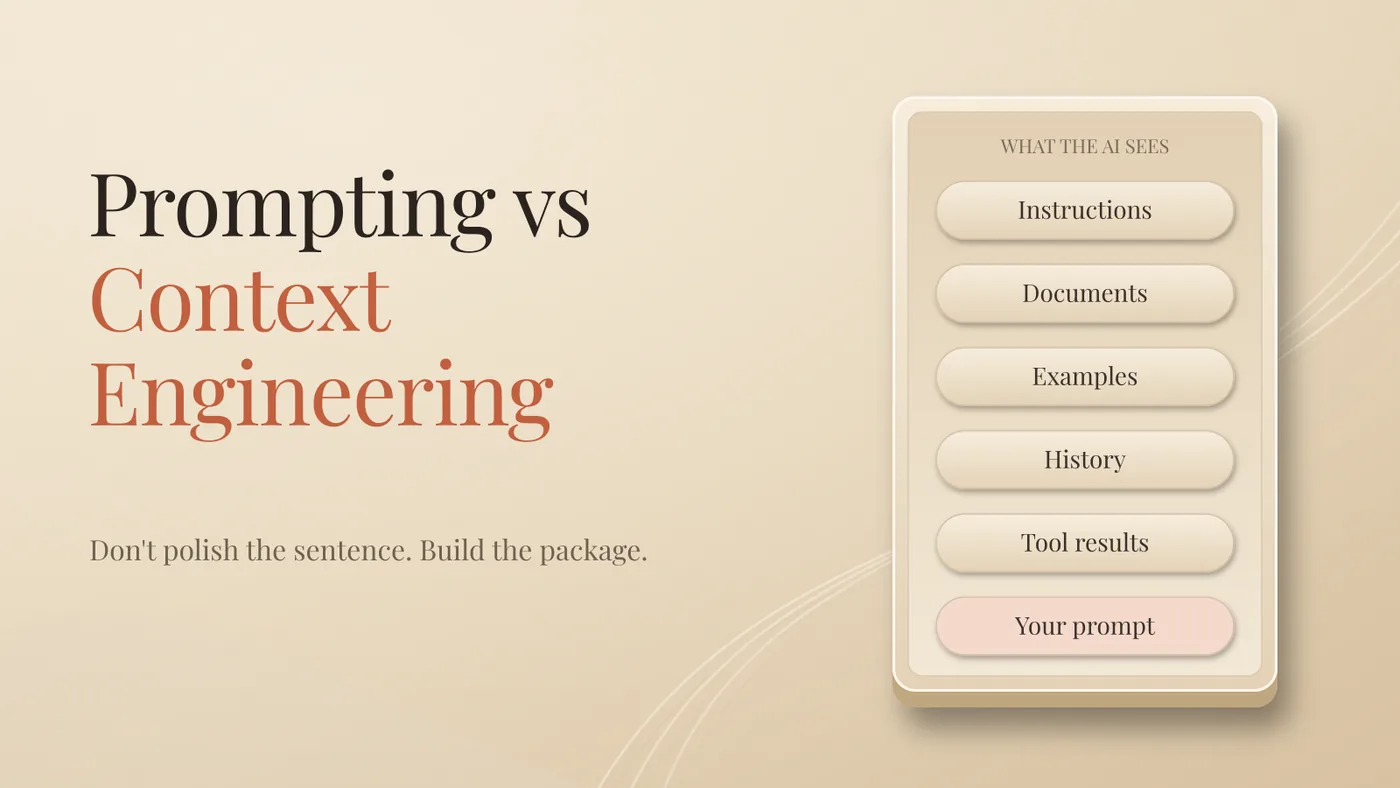
Prompting is writing the request. Context engineering is deciding everything the AI sees when it answers that request: the request itself, plus your documents, examples, history, memory and tool results.
The prompt is one line in the package. Context engineering is the whole package.
What is the difference between prompting and context engineering?
Prompting asks "how do I phrase this?". Context engineering asks "what does the AI need to see, and what should it not see?"
A prompt is one message. The context is everything around it. And the AI can only work with what's in front of it. It can't ask your colleague. It can't open your order system, unless you gave it a tool for that.
So when the answer is wrong, the question is rarely "were my words good enough?". The question is "did it have what it needed?"
Why does the same AI give different results for different people?
Because they give it different context. Same model, different package, different answer.
One person types a single line. Another pastes the relevant document, an example of what good looks like, and the rules. The model is identical. The input isn't.
The same goes for apps. Two products built on the same model can behave very differently, because each one decides what goes into the package: hidden instructions, which tools are available, how history is handled. That setup around the model is a topic on its own.
Why did people start saying "context engineering"?
Because AI work moved from single chats to agents. The term caught on in 2025.
A chat is one question, one answer. An agent runs many steps. It calls a tool, reads the result, calls another tool, writes a draft, checks it. Every step adds text to the package. After twenty steps it's huge, and someone has to decide what stays in.
Anthropic describes context engineering as the natural next step after prompt engineering. Their advice is to give the model the smallest set of high-signal information that makes a good result most likely. Small and sharp beats big and noisy.
What goes into the context, besides your prompt?
More than most people think.
Instructions. Hidden app rules, your custom instructions, project instructions.
Documents. Files you upload, passages fetched by search.
Examples. Samples of what good looks like.
History. Every earlier message in the chat, from both sides.
Memory. Saved notes about you that some apps add quietly.
Tools. This one surprises people. The description of every connected tool sits in the context. So does every result a tool sends back. Connect fifteen tools and the AI reads fifteen descriptions before it reads your question.
All of it competes for the same attention.
How do you fix a failing answer with context, not wording?
Stop rewriting the sentence. Add what's missing, remove what isn't needed.
Let's keep it simple and take one job.
This is a made-up example, to show the method. Not a story from my own business.
A customer emails: their order is a week late and they're annoyed. You ask the AI:
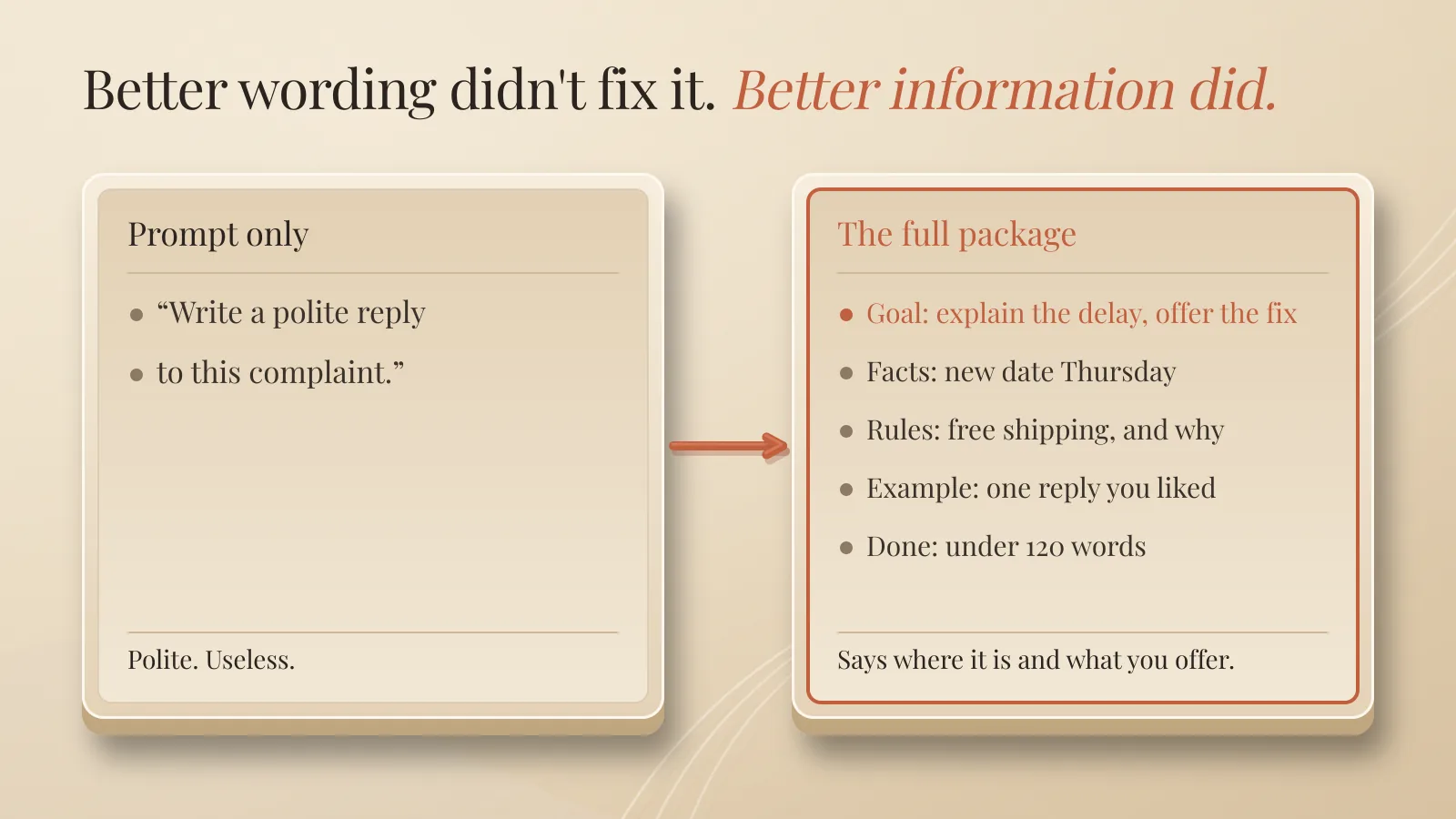
"Write a polite reply to this complaint."
You get a reply that's polite and useless. It apologises, promises to "look into it", and offers nothing. You try "make it warmer". Then "more professional". Still useless.
The wording was never the problem. The AI doesn't know where the parcel is, what you're allowed to offer, or how you normally write.
So you build the package instead.
The goal. "Draft a reply that explains the delay and offers the right compensation."
The facts. The order details and the courier's tracking status: stuck in a depot, new delivery date Thursday.
The rules. "For delays over five days we offer free shipping on the next order. No cash refunds unless the customer asks to cancel. Because a refund is final and we'd rather keep the customer."
One example. A reply you sent before and liked.
Done looks like. "Under 120 words. Subject line plus body. List anything you had to assume."
Same model. Now the draft says where the parcel is, when it arrives, and what you're offering. You edit one sentence, not the whole thing.
And it stays a draft. Anything that spends money or goes out in your name waits for your yes.
Do prompts still matter?
Yes. The prompt is still the part of the context you write yourself.
What works hasn't changed much. State the goal, the limits and the format. Give the reason behind a rule, so the AI can apply it to cases the rule didn't cover. Show an example when you can. Both Anthropic and OpenAI recommend this in their guides.
One warning on examples: models pick up their patterns, including the ones you didn't mean. If your sample opens with a stiff sentence, expect every draft to open with one.
What changed is what you can expect from a prompt. It can't fix missing facts.
How much context is too much?
More than you need is too much. Anthropic calls the effect context rot: the longer the context, the worse the model gets at using any one piece of it. Chroma measured the same pattern across 18 models.
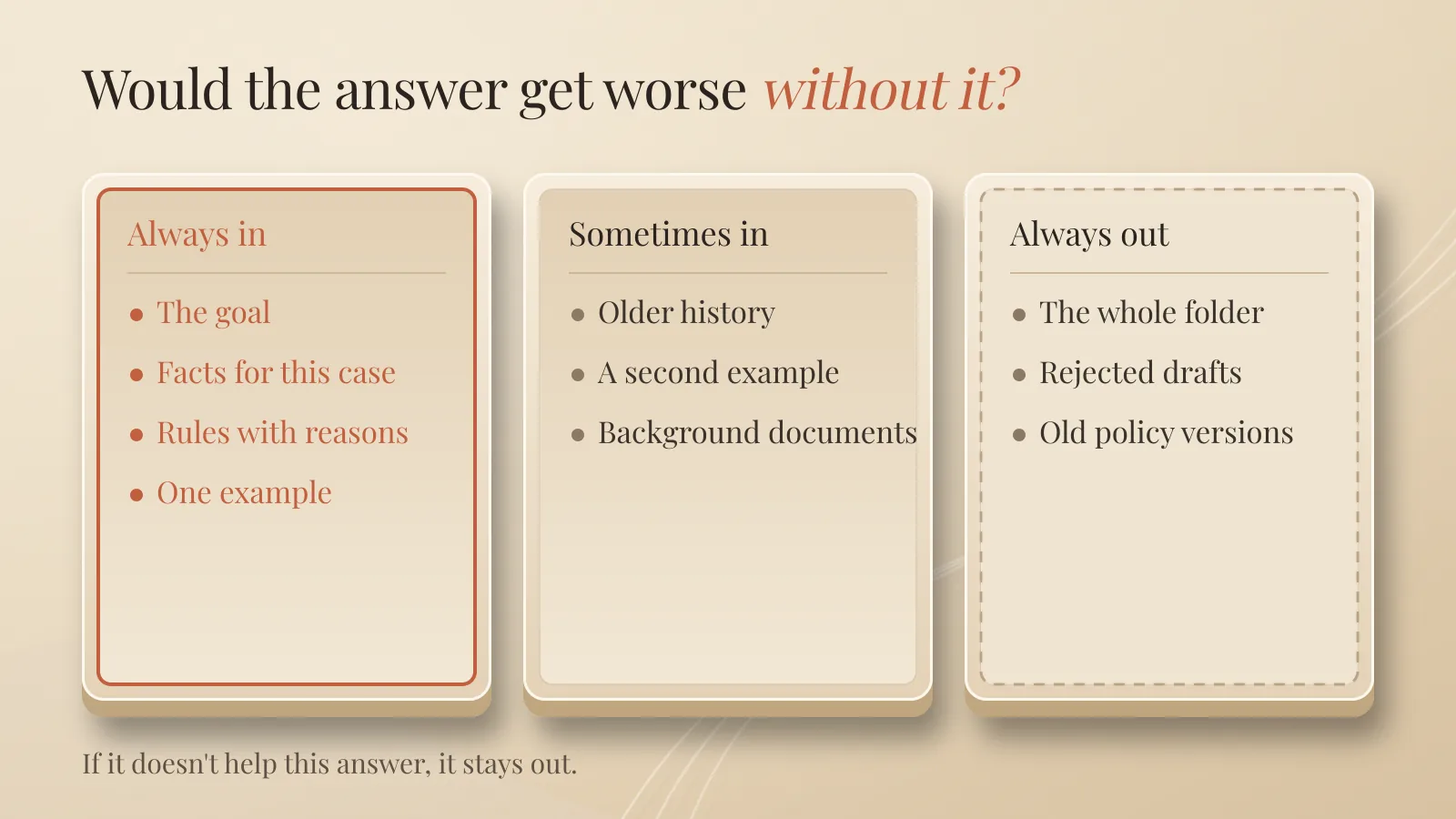
My test is simple. For every item, I ask: would the answer get worse without it? If not, it stays out.
It helps to write it down once, on one page.
Always in: the goal, the facts for this case, the rules with their reasons, one example.
Sometimes in: older history, a second example, background documents.
Always out: the whole folder "just in case", rejected drafts, old versions of the same policy.
When a chat gets long and messy, ask for a short summary of what was decided, and start a fresh chat with it.
How do teams make this repeatable?
Keep a shared library of briefs. One saved brief per recurring task: customer complaints, supplier follow-ups, weekly reports.
Each brief holds the goal, the rules with reasons, one good example, and what done looks like. Store it as project instructions where your tool allows it, so nobody retypes it.
Then look at it once a month. Where people keep editing the output by hand, the brief is missing something. Fix the brief, not the output.
Turning a good brief into a proper written process is a topic on its own.
Quick answers
Is prompt engineering dead?
No. It's one part of context engineering. Clear instructions still matter, they're just not the whole job.
Do I need to code to do context engineering?
No. Deciding what to paste, what to leave out, and when to start fresh already counts.
Is a bigger context window the fix?
No. More room doesn't mean better reading. Relevance beats volume.
Why does my AI give generic answers?
Usually it's missing facts, rules or an example. It fills the gaps with the most average answer.
The takeaway
Don't polish the sentence. Build the package.
The right facts, the rules with their reasons, one good example. Leave the rest out.
Further reading: AI Tokens Explained: What You're Actually Paying For and AIO: The Invisible Force Deciding Who Gets Found and Who Doesn't
About Me

I’m Laurent Terrijn, an entrepreneur and engineer. I see myself as a systems engineer and business builder: I build the systems businesses run on. I’m also a nerd who somehow ended up speaking ten languages. I love learning, and that curiosity pulled me deep into personal branding and artificial intelligence. On the side, explaining AI has become a passion project. I enjoy taking something that sounds complicated and making it simple enough for busy business people to understand. I do it out of curiosity, and because I like sharing what I find out. Read more on www.laurentterrijn.com
Disclaimer
I used AI to help with drafting, proofreading and checking this article.
Sources
- Anthropic, Effective context engineering for AI agents
- Anthropic, Prompting best practices
- Anthropic, Writing effective tools for agents, with agents
- OpenAI, Optimizing LLM accuracy
- Chroma, Context Rot: How Increasing Input Tokens Impacts LLM Performance
- Liu et al., Lost in the Middle: How Language Models Use Long Contexts (TACL, 2024)