An AI answer doesn't quote your page. It quotes a few sentences from your page.
So the question isn't "is my page good?" It's "can a machine lift one passage out of it, and does that passage still make sense on its own?"
That's a writing skill. It's actually not that difficult. Let's keep it simple and take one page, start to finish.
What does an AI search engine actually take from your page?
A passage, not the page. The system finds pages that match a question, pulls out the sentences that look like an answer, and builds its reply from those.
This is a made-up example, to show the method. Not a client of mine.
A small furniture workshop makes custom oak dining tables. The question every customer asks: how long does a custom table take?
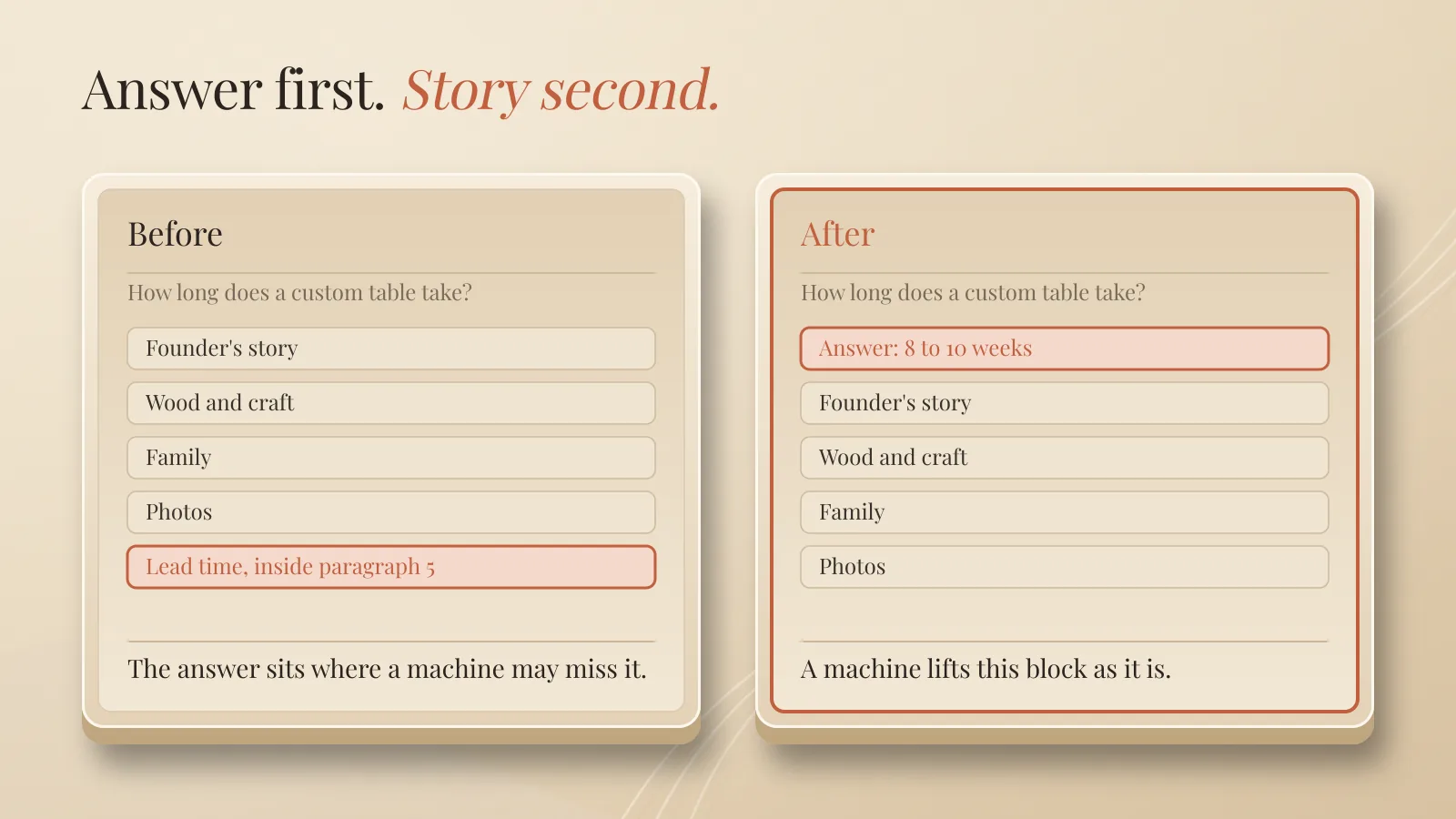
The workshop's page opens with the founder's story. Three paragraphs about wood, family and craft. The lead time sits in paragraph five, inside a sentence about drying times.
A person might scroll that far. A machine looking for a clean answer probably won't use it. Research on language models backs this up: they use information at the start and the end of a long text better than what sits in the middle.
The story can stay. It just can't go first.
How do you write an answer block?
Put the full answer in the first two to four sentences under the heading, written so it still works if someone copies only those lines.
For the workshop, that becomes:
"A custom oak dining table takes eight to ten weeks from order to delivery. Most of that time is the wood drying and the finish curing. Rush orders aren't possible, because drying can't be sped up without the wood cracking later."
Again, made-up numbers for a made-up workshop.
Three checks before you move on.
Does it answer the title? Not the topic. The exact question.
Does it stand alone? No "as mentioned above", no "this", no "it" pointing to something earlier.
Is there something specific in it? A number, a reason, a condition. "It depends" is not an answer anyone can quote.
Then the story, the details and the photos come after. Same page, better order.
What makes a passage worth citing?
Something only you can say. If ten pages give the same generic answer, there's no reason to pick yours.
The workshop knows things nobody else knows. Its real lead time. Why it refuses rush orders. What happens when a customer orders in December. That's the information worth writing down, plainly.
A research paper on "generative engine optimisation" tested this. Adding sources, quotes and statistics to content made it show up more in AI-generated answers. Keyword stuffing gave little to no improvement.
One honest caveat: that study measured visibility inside generated answers on a research benchmark. Not clicks. Not sales. A strong hint, not a promise.
How do you write FAQ answers that get quoted?
Use questions real customers ask, answer each one in the first sentence, and keep every answer self-contained.
The workshop doesn't need to guess its questions. They're in its inbox. Can I pick the wood? Do you deliver abroad? What if the table doesn't fit?
My rule: if nobody ever asked it, it doesn't go in the FAQ.
Each answer opens with the answer itself. "Can I pick the wood?" gets "Yes" as its first word. Then one or two sentences of detail. Four to six questions per page is plenty.
Skip anything a heading above already covers. The FAQ is for the leftovers: what a customer still wonders after reading the whole page.
Does schema markup still matter for AI search?
Less than people sell it. Google says its AI features don't need any special schema, and it no longer shows the FAQ dropdowns in its results.
FAQ markup is still valid schema.org code. If you keep it, make sure it matches what visitors can see, because Google's rules say markup must reflect visible content.
One kind of markup does keep its value: the kind that says who you are. That's the next point.
Why does a consistent name matter?
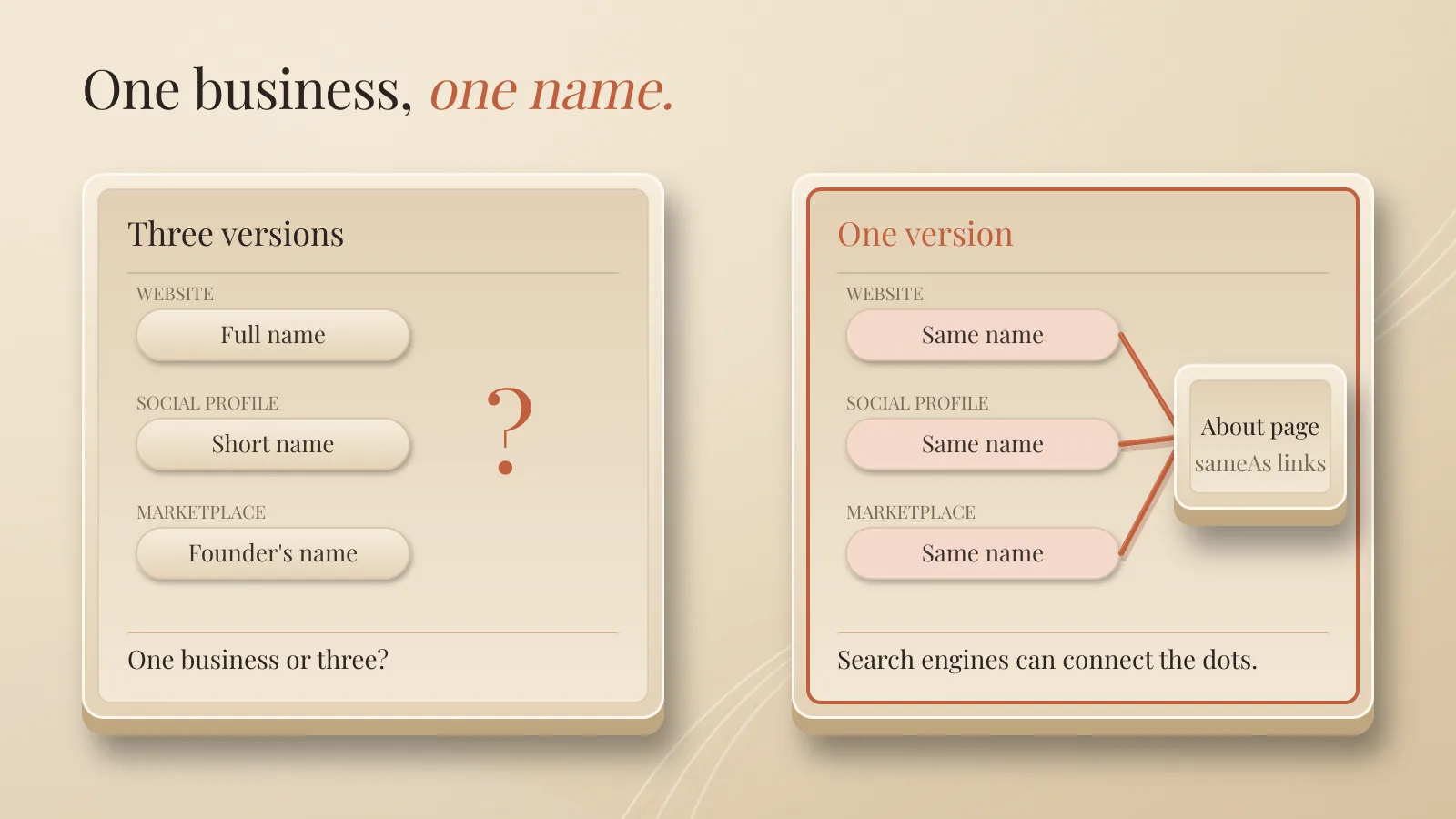
Because these systems build a picture of you by connecting mentions across the web. If the details don't match, they may not connect.
Say the workshop is called one thing on its website, a shortened version on Instagram, and the founder's own name on a marketplace profile. Three names. Three different addresses. A machine has to guess whether that's one business or three.
Pick one version and copy it everywhere. Same name, same spelling, same one-line description, same main link.
Then add Person or Organisation markup on your About page, with a sameAs list pointing to the profiles you actually control. That tells search engines these accounts belong together. No promise of a reward. Just one less thing for a machine to get wrong.
How do you keep a page fresh without rewriting it?
Change the fact, not the whole page. Then show a dated "Updated" line.
If the workshop's lead time goes from eight weeks to twelve, it edits one sentence in the answer block and one FAQ answer. Done. Rewriting the whole page every month for a "fresh" signal is churn, not freshness.
How do you check if it's working?
Once a month, ask the AI assistants your own customers' questions, and note who gets cited.
Keep a simple sheet: date, question, who appeared, correct or not. Then check the free reports. Google Search Console and Bing Webmaster Tools have both started reporting some data on AI answers. Neither is complete. Together with your sheet, they're enough.
If a competitor gets cited for your best question, fix that page before you write a new one.
What can you stop doing?
Three things.
Paying for llms.txt as a strategy. Google says its search ignores files like that.
AI rewrites of every page. Google says you don't have to write specially for AI. Write clearly for people.
Publishing one page per variation of a question. Google says pages made mainly to game its results that way break its spam rules. Write the one page properly instead.
Quick answers
Do I need to write differently for AI search?
No. Put the answer first and make each passage stand alone. That helps people too.
How long should an answer block be?
Two to four sentences. Long enough to fully answer, short enough to quote.
Does FAQ schema get me cited?
No. Clear, visible, specific answers do. Markup only helps describe them.
How often should I check AI citations?
Monthly is enough. Same questions every time, so you can compare.
The takeaway
Take the page that matters most to your business.
Move the answer to the top. Make it stand alone. Put one fact in it that only you know.
Then make sure your name looks the same everywhere it appears. That's most of the work.
Further reading: AIO: The Invisible Force Deciding Who Gets Found and Who Doesn't and Why AI Optimization (AIO) Is the New SEO
About Me

I’m Laurent Terrijn, an entrepreneur and engineer. I see myself as a systems engineer and business builder: I build the systems businesses run on. I’m also a nerd who somehow ended up speaking ten languages. I love learning, and that curiosity pulled me deep into personal branding and artificial intelligence. On the side, explaining AI has become a passion project. I enjoy taking something that sounds complicated and making it simple enough for busy business people to understand. I do it out of curiosity, and because I like sharing what I find out. Read more on www.laurentterrijn.com
Disclaimer
I used AI to help with drafting, proofreading and checking this article.
Sources
- Google Search Central, AI features and your website
- Google Search Central, Optimizing for generative AI features on Google Search
- Google Search Central, General structured data guidelines
- Google Search Central, ProfilePage structured data
- Google Search Central, FAQ structured data (rich result no longer shown)
- Liu et al., Lost in the Middle: How Language Models Use Long Contexts (TACL, 2024)
- Aggarwal et al., GEO: Generative Engine Optimization (KDD 2024)
- Google Search Central blog, Introducing Search Generative AI performance reports in Search Console
- Bing Webmaster Blog, Introducing AI Performance in Bing Webmaster Tools Public Preview