
Every AI cost comes back to tokens. Small chunks of text going in, and small chunks coming out.
The surprise for most people: the question you type is the cheap part. The context you send along with it, often without noticing, is where the money goes.
Understand that, and you control the bill.
What is a token?
A token is a piece of text the model reads or writes. Sometimes a whole word, often part of one, sometimes a space or a punctuation mark.
OpenAI's rule of thumb: in English, one token is roughly three quarters of a word. Other languages split differently, and so do different models.
The model never sees words. It sees tokens. And the meter counts tokens.
What exactly gets counted?
Four kinds of tokens, each with its own price.
This is a made-up example. Not a client and not my own business.
A small property rental company uses AI through an API to answer tenant emails. A tenant writes: "The heating isn't working, can someone come?"
- Input tokens. Everything the model reads: the company's instructions, the tenant's email, the earlier emails in the thread, the property details, even the descriptions of tools the model may use.
- Output tokens. Everything the model writes back. Output is priced higher than input.
- Reasoning tokens. Models that think before answering write hidden text. OpenAI bills it as output, even though you never read it.
- Cached tokens. Input that repeats every time, like the company's instructions, can be cached and billed at a much lower rate.
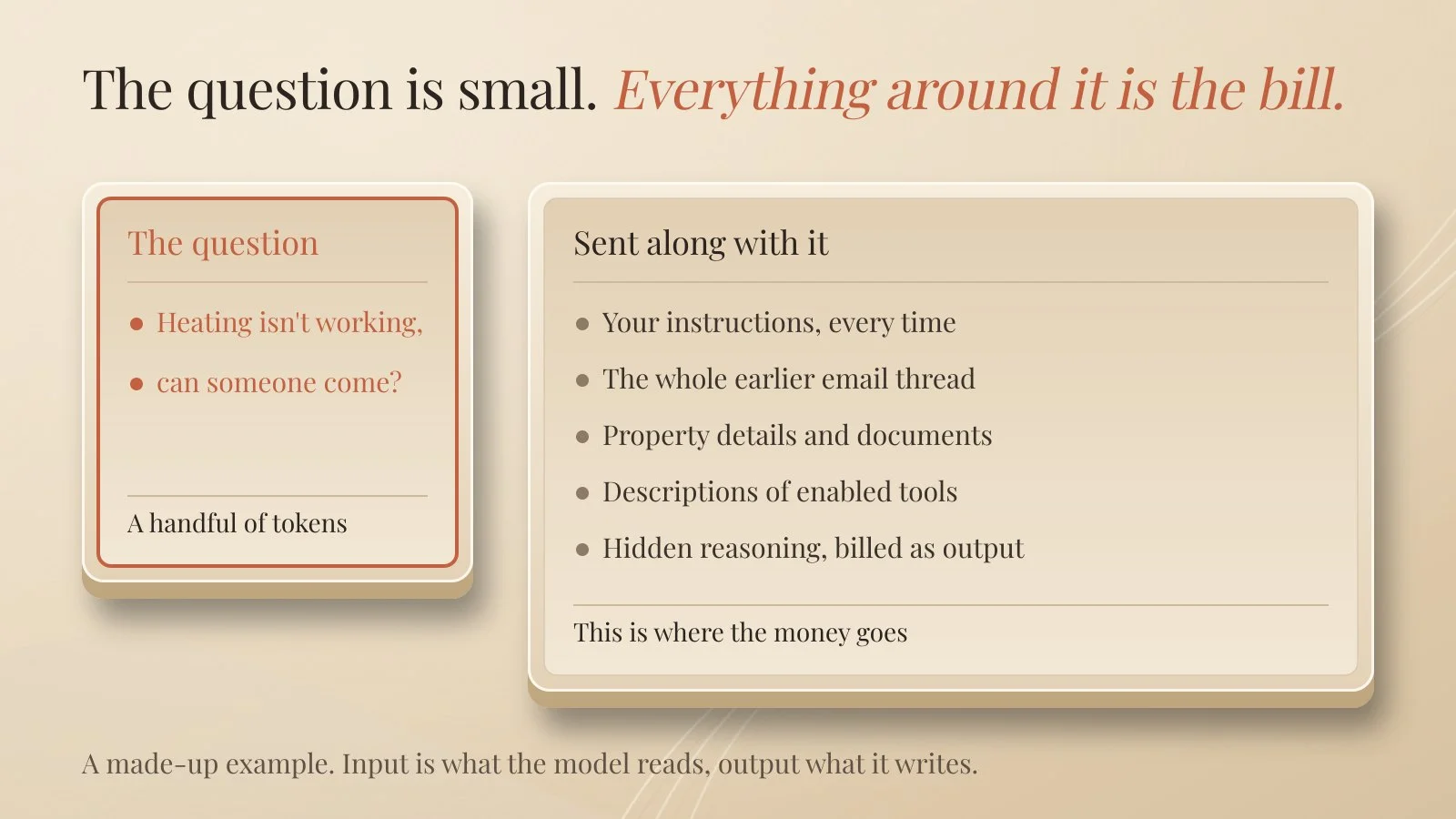
The tenant's question is a handful of tokens. Everything around it is the real cost.
How do tokens turn into a price?
On an API you pay per token, usually quoted per million. One rate for input, a higher rate for output. The math is simple: input times its rate, plus output times its rate.
A monthly subscription works differently. You pay a fixed price and get usage limits. Those limits rarely show token numbers, but tokens are behind them. Waste them, and you hit the limit sooner.
Also worth knowing: the same text can be a different number of tokens on different models. A cheaper model that writes longer answers or needs extra tries can end up costing more. So compare the cost of the whole task, not the price per token.
Where does the bill grow without you noticing?
- Long conversations. In a chat, the whole thread goes back to the model with every new message. Old messages keep getting paid for.
- Long answers and heavy thinking. Output is the expensive side, and reasoning counts as output.
- Big attachments and extra tools. Every file and every enabled tool adds input to each request, used or not.
- Agents running in loops. Each step can resend the context. Without a limit, the count keeps climbing.
For the rental company: if the tool sends the full email history and all property documents with every reply, a long-running tenant thread gets paid for again and again.
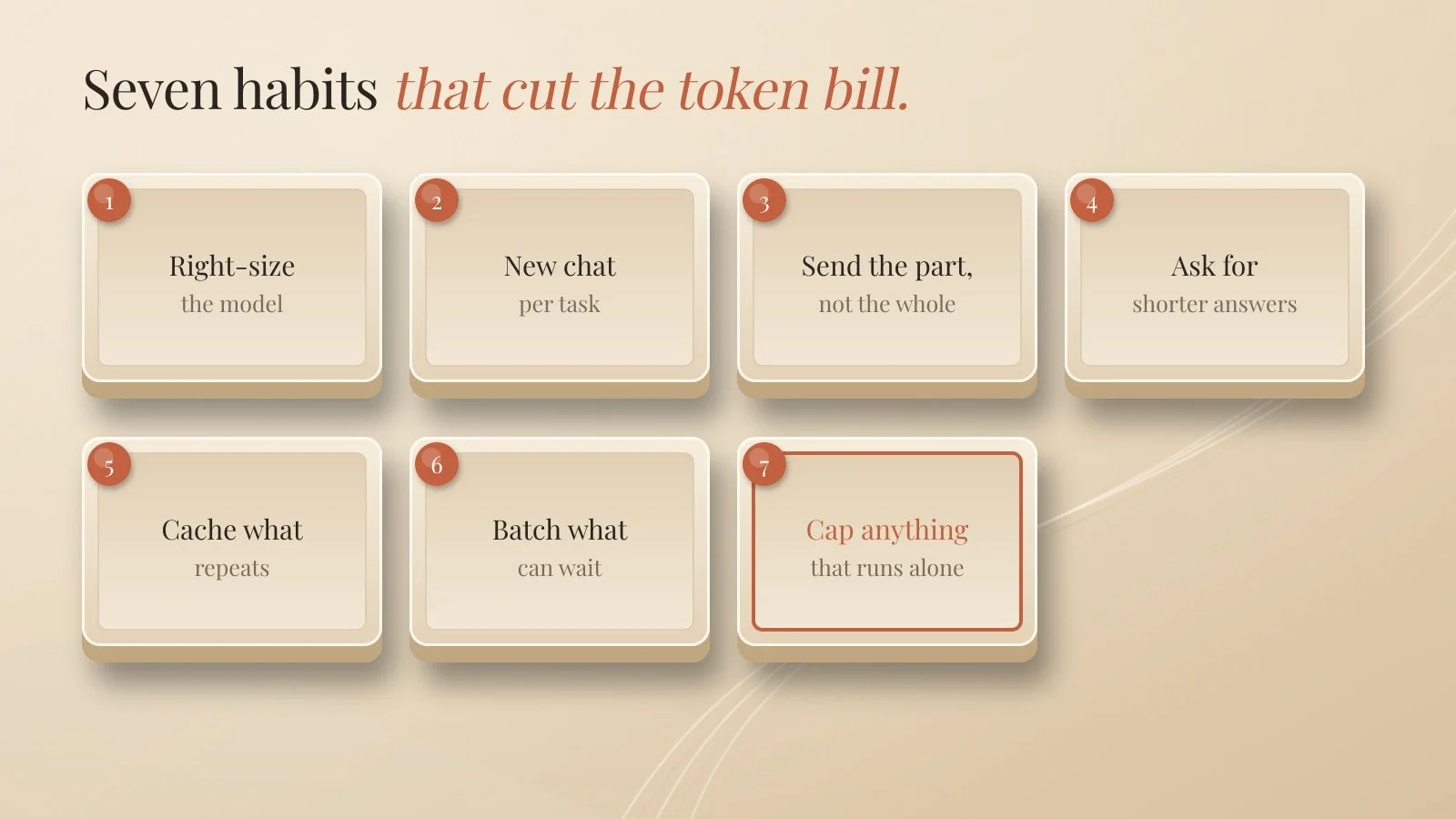
Which seven habits cut the cost?
None of them need technical skills.
- Match the model to the job. A small model for sorting and short replies. The big one only for hard thinking.
- Start a new chat per task. Carry over a short summary, not the whole history.
- Send the relevant part. The paragraph from the lease, not all forty pages.
- Ask for shorter answers. "Reply in five lines" is a cost control.
- Cache what repeats. Fixed instructions can be cached.
- Batch what can wait. Some providers discount jobs that don't need an instant answer.
- Cap anything that runs alone. A budget and a maximum number of steps per agent run, set outside the model.
My own rule: anything that spends money waits for my approval. An agent without a cap is spending money without asking.
Subscription or pay per token?
- Subscription when a person uses AI in a chat app. Fixed price, predictable, with limits.
- Pay per token when AI runs inside your own tools, like the tenant email drafts. You pay exactly for use, but the bill moves with volume and with mistakes.
Many businesses use both.
How do you check your AI costs each month?
Ten minutes is enough.
- Open the usage page. Which model and which feature used the most?
- Compare input and output. Input far bigger than output usually means long history or large files sent repeatedly.
- Look at cost per finished task. What did one tenant reply cost?
- Check caps and alerts. Is there a daily limit and a warning before you hit it?
Fix the biggest line first.
Quick answers
Is a token the same as a word? No. In English a token is about three quarters of a word on average. It varies by language and model.
Why does output cost more than input? That's how the main providers price it. Their pricing pages show a higher rate for output.
Do ChatGPT or Claude subscriptions charge per token? No. They charge a monthly price with usage limits. The API charges per token.
What's the quickest way to lower AI costs? Use the right model size, send less context and ask for shorter answers.
The takeaway
You pay for text in and text out.
The question is cheap. The history, the files and the long answers are what you're really paying for.
Send less, ask for less, and put a cap on anything that runs without you.
Further reading:
Prompting vs Context Engineering and What Is a Context Window?
About Me

I’m Laurent Terrijn, an entrepreneur and engineer. I see myself as a systems engineer and business builder: I build the systems businesses run on. I’m also a nerd who somehow ended up speaking ten languages. I love learning, and that curiosity pulled me deep into personal branding and artificial intelligence. On the side, explaining AI has become a passion project. I enjoy taking something that sounds complicated and making it simple enough for busy business people to understand. I do it out of curiosity, and because I like sharing what I find out.
Read more on www.laurentterrijn.com